
A deal is only great if you actually need it. Countdown timers, "only 3 left" banners and flash sales are designed to make you decide fast, before you've had time to think. That pressure is the point: when we feel we might miss out, we spend more and plan less.
The good news is that a few simple habits take most of that pressure away. We asked the SmartSaver team for the tips they actually use themselves.
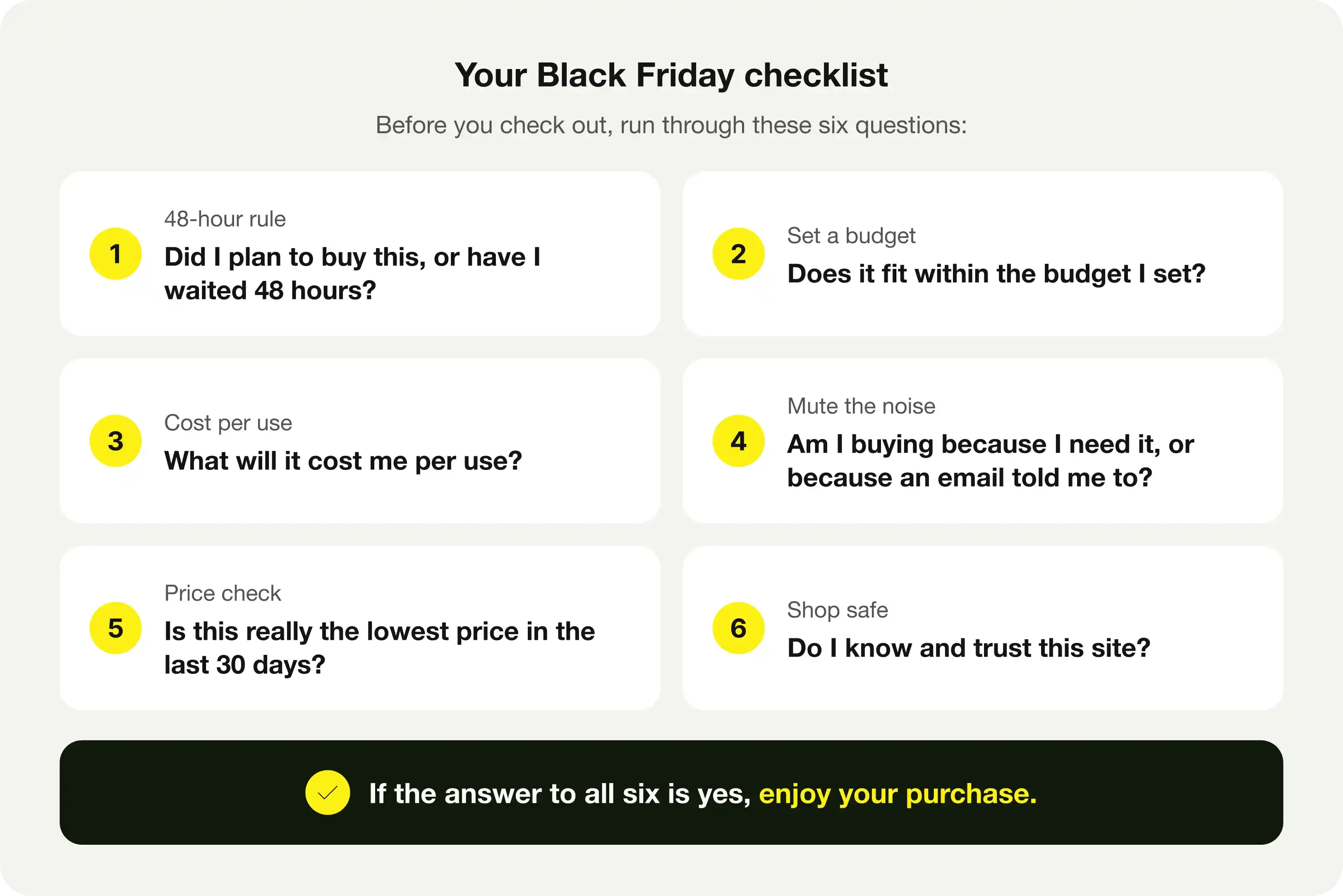
Here are six of them, with a little more detail on how to make each one work for you this Black Friday.
1. The 48-hour rule
Spotted something you didn't plan to buy? Wait 48 hours before you check out. If you still want it after two days, go for it. More often than not, the urge fades.
Impulse buys are driven by the moment: a striking photo, a big red percentage, a timer ticking down. Giving yourself time lets the excitement settle so you can ask a calmer question: would I have bought this at full price next month?
How to make it work:
- Add the item to your basket or wishlist instead of buying it straight away.
- Set a reminder on your phone for two days' time.
- When the reminder goes off, ask yourself whether you've thought about the item since. If you haven't, you probably don't need it.
Worried the deal will end? Many Black Friday offers run until Cyber Monday, and plenty return in January sales. If an offer does disappear, you've kept the money.
2. Set a budget
Decide how much you'll spend before you start shopping, then stick to it. A number set in advance is far easier to keep than one you make up as you go.
How to make it work:
- Write a short list of what you actually need or have been waiting to buy.
- Put a spending limit next to each item, and a total for the whole weekend.
- Base your total on what's left after your regular bills and savings, not on what's available on a card.
- Keep a running tally as you buy. Once you hit your total, you're done.
If you find a great deal on something that isn't on your list, it has to fit within the budget you already set. Swap it for something else, or let it go.
3. Think cost per use
The price tag only tells you part of the story. A better question is how much each use will cost you.
To work it out, divide the price by the number of times you realistically expect to use it:
| Item | Price | Times used | Cost per use |
|---|---|---|---|
| Winter jacket | €100 | 100 | €1.00 |
| Party top | €30 | 1 | €30.00 |
The "cheap" top turns out to be thirty times more expensive per wear. Cost per use is a quick way to spot whether a discount is good value or just a low price. Be honest about the number of uses: if you can't picture when you'd use it, the real figure is probably close to one.
4. Mute the noise
Fewer emails mean fewer temptations. Black Friday week is when retailers send the most marketing, and every message is built to get you clicking.
How to make it work:
- Unsubscribe from newsletters you never open. The link is usually at the bottom of the email.
- Turn off push notifications from shopping apps, at least until the sales are over.
- Unfollow or mute brand accounts on social media if their posts tend to tempt you.
- Planning to shop with one specific retailer? Check their site directly when you're ready, rather than waiting for their emails.
You won't miss the deals you need. You'll just stop seeing the ones you don't.
5. Price check
Some discounts aren't as big as they look. A price can be raised in the weeks before a sale, so the "was" price makes the saving seem larger than it is.
Before you buy, look up the item's lowest price over the last 30 days. In the EU, shops that advertise a price reduction must show the lowest price they charged in the previous 30 days, so look for it on the product page.
You can also:
- Use a price-comparison site to see what other retailers are charging.
- Use a price-history tool or browser extension to see how the price has moved.
- Search the exact model number, as retailers sometimes sell slightly different versions under similar names.
If the "deal" price is the same as last month's normal price, it isn't really a deal.
6. Shop safe
Black Friday is a busy time for scammers as well as shoppers. Fake shops, copycat websites and phishing emails all spike when people are hunting for bargains.
How to protect yourself:
- Buy only from sites you know and trust. Type the address in yourself rather than clicking links in emails, texts or ads, and check the spelling of the web address carefully.
- Use a unique password for every shopping account. If one site is breached, your other accounts stay safe. A password manager makes this easy.
- Turn on two-factor authentication (2FA) wherever it's offered, so a stolen password alone isn't enough to get into your account.
- Check before you pay. Look for "https" and a padlock in the address bar, and be wary of sellers who ask for bank transfers or unusual payment methods.
- If a deal looks too good to be true, it probably is. A brand-new phone at 80% off from a site you've never heard of is a warning sign, not a bargain.
If something feels off after you've paid, contact your bank or card provider straight away.
Keeping your account safe
Keeping your money safe and secure is important on Black Friday, and every other day really. That's why we recently launched two-factor authentication (2FA) across our app and web platforms, alongside biometric verification in the app.
2FA adds a second check when you log in, so even if someone gets hold of your password, they can't get into your account without it. If you haven't turned it on yet, it only takes a minute: turn on 2FA now.
Stay safe, and stay smart, this Black Friday.
Capital at risk. SmartSaver is an investment platform, not a savings account or bank product, and returns are not guaranteed. Read the full terms at monefit.com/en/legal.
The information presented in this blog post is valid as of the time it is published. The content is intended to provide information only and is not meant and should not be considered as financial or investment advice of any kind.